Dwarf Neon Rainbowfish
Melanotaenia praecox
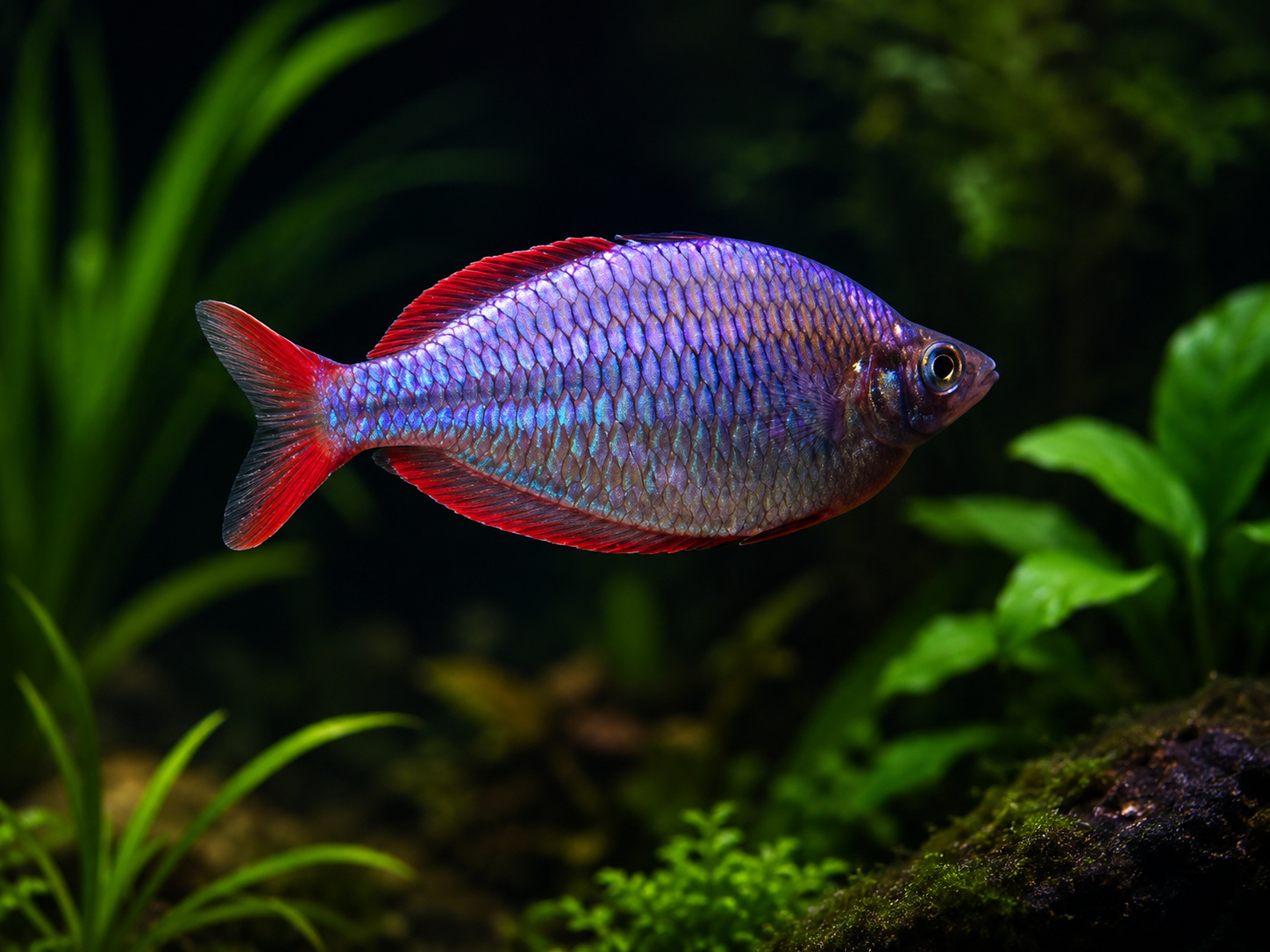
The Dwarf Neon Rainbowfish, also commonly called the Praecox Rainbowfish or Neon Rainbowfish, is a compact freshwater schooling fish with a brilliant metallic-blue sheen. Under aquarium lighting, its reflective scales flash shades of electric blue, turquoise, and silver as it moves through the water.
Mature males are especially striking, developing deeper bodies and vivid red to orange fins. Females typically have a more streamlined profile with subtler silver-blue coloration and yellow to orange fins. Keeping both sexes together encourages the males to display their strongest coloration.
Despite its relatively small adult size, Melanotaenia praecox is an active swimmer that should not be kept in a cramped aquarium. A planted community tank with open horizontal swimming space provides the best environment for this energetic species.
Quick Care Guide
| Care Requirement | Recommendation |
|---|---|
| Scientific Name | Melanotaenia praecox |
| Common Names | Dwarf Neon Rainbowfish, Praecox Rainbowfish, Neon Rainbowfish |
| Adult Size | Approximately 2–3 inches |
| Temperament | Peaceful, active, social |
| Care Level | Beginner to intermediate |
| Minimum Aquarium Size | 20-gallon long aquarium; larger is preferred |
| Recommended Group Size | At least 6; groups of 8 or more create a stronger display |
| Temperature | 74–80°F |
| pH Range | 6.5–8.0 |
| Water Hardness | Moderate to moderately hard water preferred |
| Diet | Omnivorous |
| Swimming Level | Middle and upper levels |
| Plant Safe | Yes |
| Reef Safe | Freshwater species only |
Natural Habitat
Melanotaenia praecox originates from the Mamberamo River drainage in northern New Guinea, Indonesia. In the wild, these rainbowfish are associated with tropical freshwater streams and tributaries surrounded by rainforest vegetation.
In the aquarium, they benefit from clean, well-filtered water, stable parameters, and a layout that balances planted areas with open swimming room.
Aquarium Setup
A 20-gallon long aquarium is an appropriate minimum for a small group, although a 29-gallon or larger aquarium provides better swimming space. Larger schools should be housed in correspondingly larger aquariums.
Arrange plants, driftwood, and other décor around the sides and rear of the tank while leaving the center open. This creates sheltered areas without restricting the fish’s natural schooling behavior.
Recommended aquarium features include:
- Open horizontal swimming space
- Live plants around the perimeter
- Reliable filtration
- Moderate water movement
- Stable water parameters
- A secure aquarium lid
Dwarf Neon Rainbowfish are active and look especially impressive in planted display aquariums where their reflective coloration contrasts against darker backgrounds and green foliage.
Schooling Behavior and Temperament
Dwarf Neon Rainbowfish are peaceful community fish but should not be kept alone. Maintain a group of at least six individuals. A larger group of eight or more will usually appear more confident and create a more natural visual display.
Males may chase or spar with one another, particularly when displaying for females. This behavior is usually brief and is not generally a concern when the fish are maintained in an adequately sized group with sufficient swimming room.
A mixed group containing females helps distribute attention and encourages more pronounced male coloration. A ratio of approximately one male for every one or two females works well.
Compatible Tank Mates
Melanotaenia praecox is suitable for a peaceful tropical community aquarium. Choose tank mates that are not large enough to eat them and are not excessively aggressive or slow-moving.
Suitable tank mates may include:
- Peaceful tetras
- Rasboras
- Corydoras catfish
- Smaller peaceful barbs
- Gouramis with mild temperaments
- Peaceful dwarf cichlids
- Other appropriately sized rainbowfish
- Bristlenose plecos and similar catfish
Avoid housing them with large predatory fish, highly aggressive cichlids, or species that may be stressed by their fast, active swimming behavior.
Small ornamental shrimp and shrimplets may be eaten. Larger adult shrimp may be left alone, but this cannot be guaranteed.
Feeding
Dwarf Neon Rainbowfish are omnivorous and readily accept a broad range of aquarium foods. Feed a varied diet to support strong coloration, healthy growth, and active behavior.
Suitable foods include:
- High-quality tropical flakes
- Small floating or slow-sinking pellets
- Frozen brine shrimp
- Frozen daphnia
- Frozen cyclops
- Bloodworms offered in moderation
- Live baby brine shrimp
- Small live foods
Feed small portions once or twice daily. Offer only as much food as the fish can consume within a few minutes. Their enthusiastic feeding response can make overfeeding easy.
Water Quality and Maintenance
Dwarf Neon Rainbowfish are adaptable, but they perform best in clean, stable water. Maintain consistent aquarium parameters rather than making rapid adjustments.
Perform routine partial water changes and monitor ammonia, nitrite, and nitrate levels. Ammonia and nitrite should remain at zero in an established aquarium.
Recommended water parameters:
| Parameter | Recommended Range |
|---|---|
| Temperature | 74–80°F |
| pH | 6.5–8.0 |
| Hardness | Moderate to moderately hard |
| Ammonia | 0 ppm |
| Nitrite | 0 ppm |
| Nitrate | Keep as low as practical through routine maintenance |
Sexual Dimorphism
Males and females become easier to distinguish as they mature.
Males generally develop:
- A deeper, more robust body shape
- Stronger metallic-blue coloration
- Brighter red to orange fins
- More intense display behavior
Females generally have:
- A more streamlined body shape
- Softer silver-blue coloration
- Yellow to orange fins
- Less intense coloration than mature males
Breeding
Dwarf Neon Rainbowfish are egg scatterers. When kept in good condition, mature fish may spawn regularly among fine-leaved plants or spawning mops.
The adults do not provide parental care and may eat eggs or newly hatched fry. For intentional breeding, move spawning mops or egg-covered plants to a separate rearing aquarium with gentle filtration.
The fry are extremely small when they become free-swimming and require appropriately sized foods such as infusoria or powdered fry food before they are large enough to accept newly hatched brine shrimp.
Important Care Notes
- Keep this species in a group rather than as a single specimen.
- Prioritize aquarium length and swimming room over decorative clutter.
- Maintain stable water quality with routine partial water changes.
- Feed a varied omnivorous diet to promote strong coloration.
- Use caution when housing them with very small shrimp or newly hatched fry.
- Provide a secure lid due to their active swimming behavior.
Why Choose the Dwarf Neon Rainbowfish?
The Dwarf Neon Rainbowfish delivers the visual impact of a larger rainbowfish in a more manageable size. Its metallic-blue body, colorful fins, peaceful temperament, and energetic schooling behavior make it an excellent choice for planted aquariums and active freshwater community displays.